
Complex Passages
In the previous section we went over the most common types of simpler passages that you’ll find in the Reading Comprehension section. In this section we’ll go over the variations for the more complex passages.
The primary difference is that in the complex passages you have more perspectives that engage in ‘dialogue’ and reference one another.
What are the common variations?
The difference between these passages and the previous ones that involved perspectives is that here the perspectives reference one another, they’re in ‘dialogue’.
Contrasting Positions
A common example is the author introducing a phenomenon and two or more perspectives on the phenomenon that have contrasting positions and explicitly challenge one another (or at least one does). This is generally the case where you have two perspectives.
Here, generally, the first paragraph introduces the situation and the second paragraph introduces two contrasting perspectives on it, with the author providing arguments/clarifications for the perspectives. In these situations the author might, as with the previous simpler situation, evaluate or critique, or they may integrate the perspectives in some way.
You may also have a chain of engagement between multiple perspectives, not just a debate between two. Here, the author generally introduces a perspective responding to the previous one introduced. And, once again, the author can take a critical view, or respond with more of a qualification, or integrate various aspects of the perspectives presented.
Restricted Content
This material is only available to my students. Please contact me if you’re interested in tutoring.
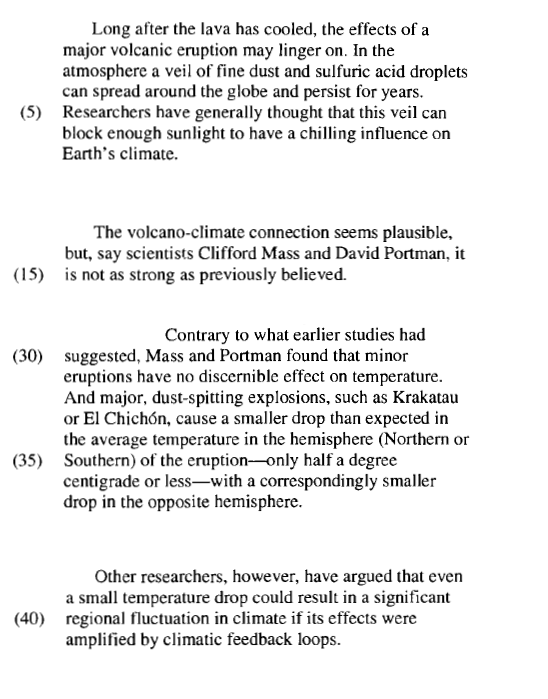
This is an example of a passage where there is a dialogue. Once again, I’ve included only the relevant parts from the passage.
The first paragraph introduces a natural phenomenon and a potential explanation of it. The remaining paragraphs introduce challenges to that explanation and responses to the challenge.
Transformative Response
An alternative way for perspectives to interact is not just through criticism but also through transformative response. The author may introduce a perspective on a phenomenon and show how it was developed in response to other perspectives.
Or they may introduce multiple perspectives which build on one another, with each perspective modifying the understanding from the previous one.
Author’s Role
And, likewise, the author can take a variety of stances, from simply presenting the interaction between the perspectives, to criticism, to qualification and integration, etc.