
main point
1.

This video covers the Main Point questions.
exercises
Click on the image to get a full-size view of the passage and question(s), read through it and do the question(s). Click on the ‘answer’ link for my explanation.
1.
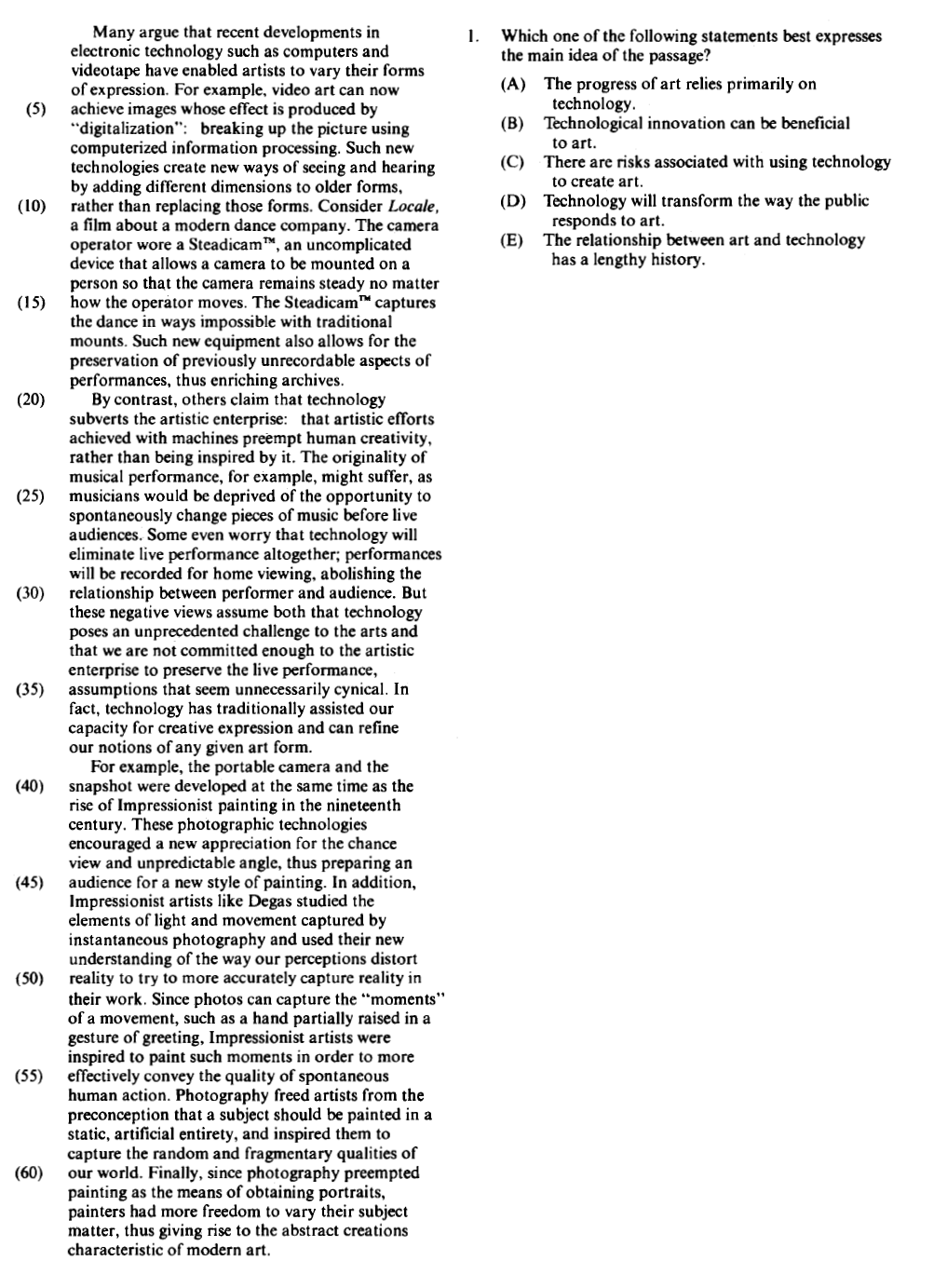
1. B
You’re being asked for the main point of the passage; you should do these questions last. Prior to approaching this question you should have an idea of the main point when you’re done with the passage by giving yourself a quick summary; look for summarizing sentences to help you. In this case the first paragraph claims that technology can help artists express themselves in different ways, the second paragraph challenges that by saying that technology can threaten both art and performance but then responds to that challenge by saying that the opposite has generally been the case, with the third paragraph providing an example.
A – This is incorrect because it’s inaccurate. The passage does give examples of situations where art progressed because of technology (the first paragraph and the third paragraph) but they aren’t presented as examples of art relying PRIMARILY on technology to progress. We aren’t told in the passage what art primarily relies on to progress or even if there is something which is the primary motor for progress.
B – This is the correct answer. The passage is structured to show that technology helps art, and although that is challenged there is also a response to the challenge. The first paragraph provides the example of the Steadicam and although the second paragraph says that live performance might suffer the third paragraph points out how the portable camera actually helped painting.
C – This is incorrect because it’s too narrow. This is in the passage but it’s only the challenge to the main point. Since the challenge is responded to in the third paragraph it’s not the overall main point.
D – This is incorrect because it’s inaccurate. The passage doesn’t talk about how technology transforms the PUBLIC’S response to art, it’s about how technology transforms the artist’s creation of art.
E – This is incorrect because it’s inaccurate and too narrow. The focus of the passage isn’t about the lengthy history between art and technology, but instead the recent developments; the example given is used to illustrate how technology can assist our capacity for creative expression and refine our notion of different forms.
2.
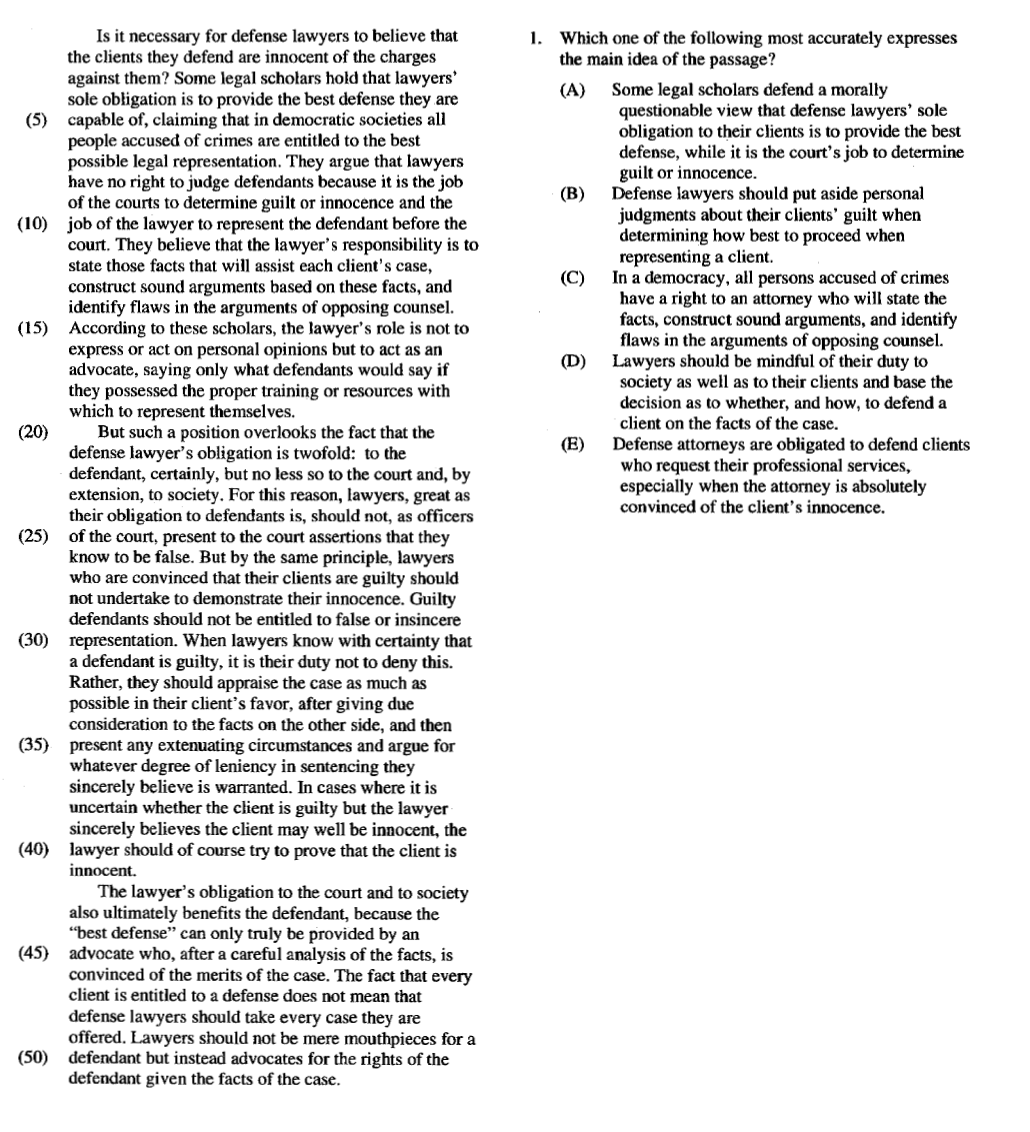
1. D
This is a main point question, and having read through the passage you should be summarizing it as you go along and you should have an idea of the main point. In this case, the author challenges a perspective: although some legal scholars believe that a lawyer’s sole obligation is to provide the best defense that they’re capable of they also have an obligation to the court and society.
A – This is not the correct answer because this only presents the perspective that is argued against, and it also characterizes that perspective as morally questionable – which is not in the passage at all.
B – This is not the correct answer because this is a supporting element in the perspective being argued against.
C – This is not the correct answer because this is also a supporting element in the perspective being argued against.
D – This is the correct answer because it states the author’s perspective as a challenge to the perspective initially introduced. That lawyers should be mindful of their duty to society is the challenge to the initial perspective that lawyers should simply provide the best defense they’re capable of.
E – This is incorrect since this is actually in contradiction to what the author says in the next to last sentence in the passage, that “lawyers should (not) take every case they are offered.”
3.
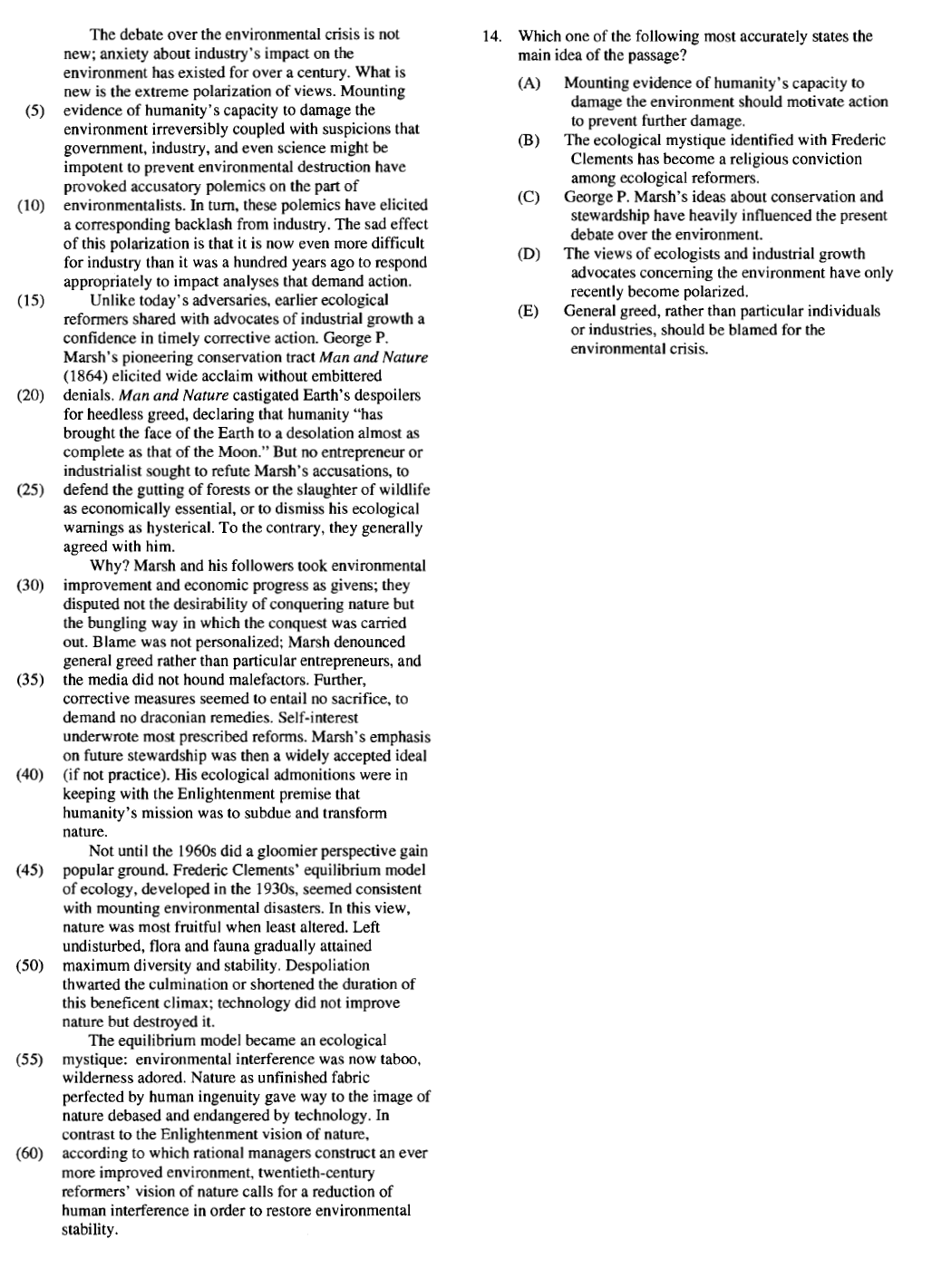
14. D
This is a main point question, and you should have a summary of the passage as you finish reading it. In this case the passage explores the contrast between earlier attitudes and contemporary attitudes towards environmental crisis.
A – This is not the correct answer; the first part of this statement is found in the third sentence of the first paragraph and it’s actually used to support the contention that comes right before – the extreme polarization of views is a new development partly because of the mounting evidence of humanity’s capacity to damage the environment. The second part, that people should be motivated to prevent further damage, is not in the passage.
B – This is incorrect because the notion of religious conviction is new information that isn’t in the passage. The passage does introduce Clements’ perspective and how it transformed into an ecological mystique, but there’s no mention of the religious conviction part.
C – This is incorrect because it’s inaccurate; Marsh’s ideas influenced the earlier, not the present, debate over the environment.
D – This is the correct answer since this is concretely stating what the difference is between the earlier and contemporary attitudes concerning the environment. This is also essentially a restatement of the second sentence of the first paragraph, which is what frames the entire passage.
E – This is incorrect because this is a statement found in the third paragraph which seeks to explain why earlier attitudes weren’t as polarized. It’s a supporting point and therefore not the main point.
4.
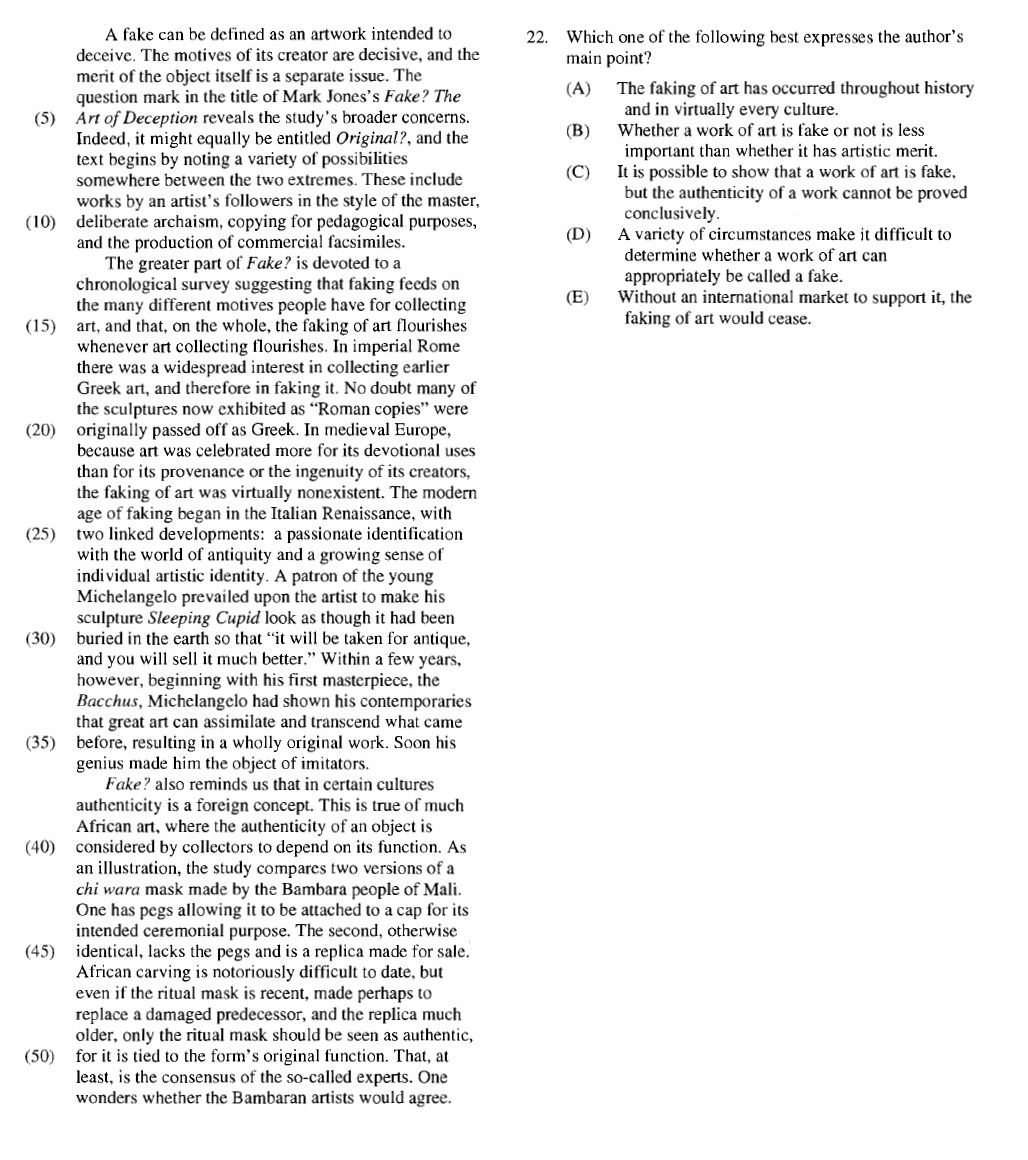
22. D
This is a main point question and you should have an idea of the overall point of the passage since you should be summarizing as you’re moving through the passage. In this case the passage as a whole gives an explanation of the concept of a ‘fake’, which is introduced along with its binary opposite, that of an ‘original’.
A – This is incorrect since it’s too extreme, it adds new information. The passage doesn’t say that faking of art has occurred in virtually every culture, it gives examples of cultures where faking has occurred but doesn’t say anything about the amount of cultures where faking has occurred vs where it hasn’t.
B – This is incorrect because the passage doesn’t consider the issue of authenticity vs merit. The last passage does evaluate authenticity against function, but function isn’t merit. And additionally, the point of the last paragraph isn’t the main point but a subsidiary point.
C – This is incorrect since the passage doesn’t say that; in the third paragraph it says that the authenticity of a work may depend on other considerations than what we would normally expect – namely, it’s function.
D – This is the correct answer, the first paragraph frames the passage as a whole and it introduces the notion of a fake by stating what determines it – that the creator is motivated by deception – and then goes on to state that there are a variety of possibilities in between a fake and an original.
E – This is incorrect since the passage doesn’t say that faking requires and international market, but that it requires art collection.
5.
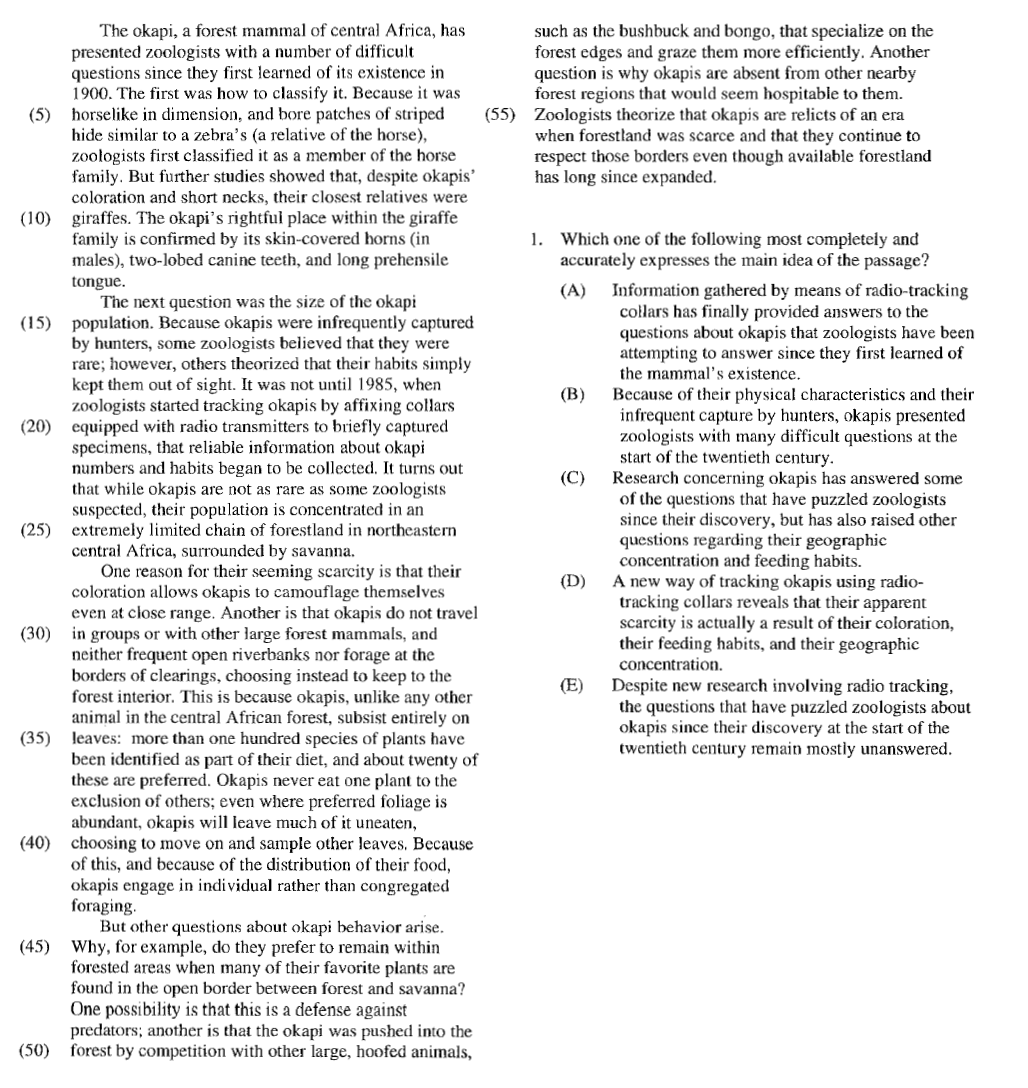
1. C
This is a main point question and having gone through the passage and summarized it as you go along the main point is essentially stated in the very first sentence, that the okapi has presented zoologists with a number of difficult questions since they first learned of its existence, and over time some of the questions have become answered.
A – This is incorrect since this is only part of what the passage talks about, the information gathered is an answer to just one of the questions that zoologists have had concerning the okapi.
B – This is incorrect since this is only part of what’s going on in the passage, the passage also details how some of the questions have been answered.
C – This is the correct answer since it states that some questions concerning the okapi have been answered, namely in the first three paragraphs; and it states that others remain – namely those brought up in the last paragraph.
D – This is incorrect since this only deals with part of what the passage is talking about, the specific questions and answers in the second and third paragraphs.
E – This is incorrect since it’s not accurate, many of the questions that puzzled zoologists have been answered.